3000+ Pumps & Parts
Pumps On Sale!
Fast Dispatch
If you fit or service pumps for a living, the Grundfos catalogue is both the best and the worst thing about the brand. Almost any duty you meet has a model that suits it. Finding that model among thousands of part numbers is the problem.
This guide is written for plumbers, service techs and resellers rather than homeowners. It covers how to read a Grundfos model code, which range takes which job, why the product number matters more than the model name when you order, and what usually goes wrong on a service call.
Learn the pattern once and you can size and cross-reference without opening a datasheet. It saves real time on site.
The first number is nominal flow in cubic metres per hour. A CR 5-8, an SP 3A-25 and an SQ 2-70 are rated around 5, 3 and 2 m³/h. Multiply by 16.7 for litres per minute, so 5 m³/h is about 83 L/min.
The second number changes meaning depending on the family. This catches people out.
The letters cover materials and control. On the CR family, plain CR is a cast iron head and base with stainless internals. CRI is 304 stainless. CRN is 316 stainless, which is what you specify for high chlorides, coastal work or anything mildly aggressive. An E on the end — CRE, CRIE, CRNE — means an integrated variable speed motor.
The long code after the model, like A-FGJ-A-E-HQQE, describes the pump head type, pipework connection, coupling and shaft seal. You rarely need to decode it in full, but you do need to match it when ordering a like-for-like replacement, because two pumps with the same CR 3-5 name can have different connections and different seal materials.

Three-inch submersibles for domestic supply, tank filling and light irrigation. The selling point for trade work is the built-in dry running protection — the pump cuts out on water shortage without an external control, which removes a component and a fault point from the install.
SQE adds electronic control for constant pressure, set up through a CU 301. Unless the client specifically wants constant pressure, a plain SQ is usually the sensible spec. See the SQ and SQE range.
Watch the cable. Voltage drop over a long bore run is the thing that catches installers out. A 1.15 kW SQ on 1.5 mm² is good for roughly 50 m of total run. Step to 2.5 mm² and that roughly doubles. Measure the whole path back to the board, not the bore depth.
Where SQ runs out of flow, SP takes over. Four inch and up, stainless construction, and the range goes a long way into irrigation, stock and commercial water supply. Check the casing diameter before you quote — a four-inch pump does not go down a three-inch bore, and that conversation is better had before delivery. Browse the SP range.

The workhorse for commercial pressure, process water, irrigation and plant rooms. Stack more stages for more head at the same flow.
The material decision is the one that matters commercially. Specifying CRN on clean rainwater wastes the client's money. Specifying plain CR on aggressive bore water gets you a warranty conversation in two years. Get a water analysis if there is any doubt.
The full CR range is here, and the smaller frames are grouped under CR 1 multistage pumps.

Domestic and light commercial pressure boosting. CMB is fixed speed, usually paired with a pressure manager. CMBE has variable speed built in, holds a set pressure and stops the constant cycling that wears out fixed-speed systems.
For retrofit work, CMBE is often the easier sell. It removes the pressure tank sizing argument and it fixes the complaint that brought you out in the first place, which is usually pressure swinging when a second outlet opens. See CMB and CMBE boosters and the wider pressure boosting range.
There are also CMB-SP self-priming booster sets where the supply sits below the pump and priming is the problem.

KP, AP and CC cover pits, sumps, lift wells and general drainage. CC is the flat-suction type for emptying down to a low residual level, which is what you want in a shower base or a plant room floor.
These are high-turnover items. If you do maintenance work, they are worth stocking rather than ordering per job. See the Unilift range.

SEG is the grinder — it macerates solids so you can pump sewage through small-bore rising mains over long distances. That is what makes it the answer for basements, rural sites and retrofits where digging a gravity line is not realistic.
SEV is SuperVortex, which passes solids whole rather than cutting them. Different job, different failure mode. Grinders block less but wear the cutter. Vortex units cope with rag better in some duties.
Note the EX variants in the model code. Those are hazardous-area rated and they are not interchangeable with standard units on price alone. See SEG grinder pumps and SEV pumps.
UPS and ALPHA circulators cover hot water and heating loops — see circulator pumps. For multi-storey and commercial pressure, Hydro Multi booster sets handle duty/standby and staged operation.
This is the single biggest source of wrong-part deliveries in this brand.
The model name is not unique. "Grundfos CR 3-5" describes a family, not a specific item. The same CR 3-5 exists in single phase and three phase, with different pump head codes, different connections and different seal materials. Each of those is a different eight-digit product number.
Two examples from the same model line:
Same name on the nameplate. Different pump, different price, and one of them will not run on the supply at the site.
When you order, quote the product number off the old nameplate. If the plate is unreadable, take a photo of the pump and the terminal box and send it through — we can usually identify it from the head casting and the connection.
Establish this before you quote, not after.
The domestic ranges, SQ bore pumps, JP jet pumps, CMB boosters and the smaller CR and CRI frames all run on 240 V single phase. Larger CR units and most of the SP range above the small frames are three phase only.
On rural jobs this decides the whole specification. If the site is single phase and the duty needs a pump that only exists in three phase, you are either changing the design or talking to the client about a supply upgrade. Better to find that out on the first visit.
For anyone doing regular service work, a few things turn a two-visit job into one.
"It hums but doesn't start." Capacitor first, nearly every time. Check for a swollen or split case. If the capacitor tests fine, look at the start winding and the thermal overload before condemning the motor.
"It keeps starting and stopping." Pressure tank before pump. Check the pre-charge with the system drained. If the tank is sound, look at the pressure switch settings, then at whether the system would be better on a variable-speed unit.
"Pressure drops when another tap opens." That is a fixed-speed system doing exactly what it is designed to do. The fix is a variable-speed pump or a pressure manager, not a bigger fixed-speed pump.
"The bore pump has stopped." On an SQ, check whether the dry-run protection has tripped before assuming a failure. Water table drop over summer is a common cause and the pump is fine.
"It runs but delivers nothing." Lost prime, blocked strainer, closed valve, or an air leak on the suction side. Check the simple things first — a suction leak is invisible and will waste an hour if you go looking at the pump instead.
"The grinder pump keeps tripping." Usually something in the cutter it cannot deal with, or a worn cutter losing its edge. Check what is going into the system before replacing the pump.
Most Grundfos work in the field is replacing an existing unit rather than a new install. Three things save trouble.
Match the connection, not just the duty. A hydraulically identical pump with a different pump head code may not line up with existing pipework. Check the connection type before you order.
Consider whether the original spec was right. If a pump has failed early, the reason is often selection rather than manufacture. An undersized unit running at the far right of its curve, or a system short-cycling against a dead pressure tank, will kill the replacement too.
Look at variable speed on retrofit. If the client's complaint is pressure fluctuation or a noisy pump cycling all night, an E-variant solves it properly rather than delaying the same callback.
Motors can be replaced separately in many cases — see Grundfos electric motors — but rule out the capacitor first, because it is a fraction of the cost.
It depends on the family. On CR and SP it is the number of impeller stages. On SQ it is head in metres. The first number is always nominal flow in m³/h.
Materials. CR is cast iron head and base with stainless internals. CRI is 304 stainless. CRN is 316 stainless for aggressive or high-chloride water. The hydraulics are the same; the wetted materials are not.
When the system has variable demand and the client cares about pressure stability or running cost. CRE, CRIE, CRNE and CMBE have integrated variable-speed motors. On a system running several hours a day the energy saving usually justifies the extra cost, and it removes cycling stress from the whole installation.
Not reliably. One model name covers multiple product numbers with different phases, connections and seal materials. Quote the eight-digit product number from the nameplate, or send a photo of the pump and terminal box.
No. Dry running protection is built into the SQ and SQE range and cuts the pump out on water shortage. Most other ranges rely on an external control, so check the specific model rather than assuming.
Depends on motor size and total run length, including the distance inside the building. Voltage drop is what you are guarding against. As a guide, a 1.15 kW SQ on 1.5 mm² is good for around 50 m of total run, roughly doubling on 2.5 mm². Give us the depth and the distance to the board and we will size it.
No. EX variants are rated for hazardous areas and carry different certification. If the original was EX-rated, the replacement must be. Do not substitute on price.
Yes. We stock the Grundfos range along with the controls, tanks and spares that go with it, and we ship Australia-wide. If you are quoting a job and want a second opinion on selection before you commit, ring it through.
Most of the failures we see trace back to selection rather than manufacture. An undersized pump run hard, a system cycling against a dead tank, or the wrong wetted material for the water.
If you have flow, head, water source and available supply, we can confirm a model and a product number quickly. Call (08) 6384 5884 or send the details through. Browse the full Grundfos range or the home and garden range for domestic work. We are at 7 Hampton St, Greenfields WA 6210.
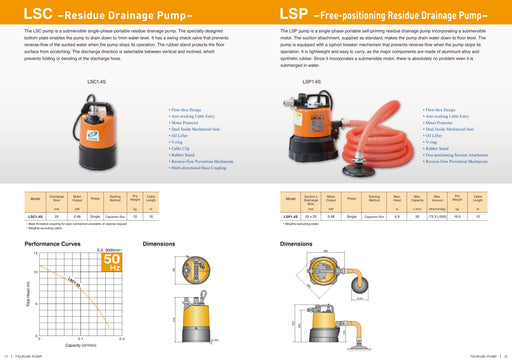
The Tsurumi LSC1.4S is a single-phase submersible portable residue drainage pump designed for ultra low-level water removal down to approximately 1...
View full detailsComplete maintenance kit for ASM D-Series diaphragm pumps, containing essential wear components to restore pump performance and reliability. Design...
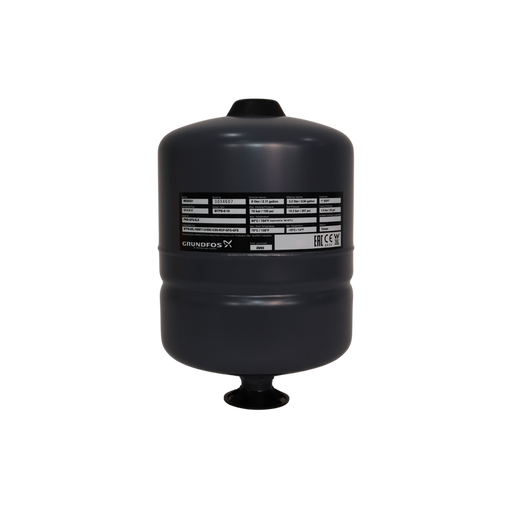
View full detailsThe Grundfos GT-H-18 PN10 G1 V is a compact steel pressure tank designed for drinking water applications. It features a non-toxic butyl rubber d...
View full detailsThe Davey Dynapond 8000 is a submersible centrifugal pond pump designed for continuous operation (24/7) in fountains, pond recirculation, wate...
View full detailsThe Tsurumi LSP1.4S is a single-phase portable self‑priming residue drainage pump incorporating a submersible motor, designed for fast removal of s...
View full details