3000+ Pumps & Parts
Pumps On Sale!
Fast Dispatch
More pump failures trace back to the pressure tank than to the pump. A tank is the cheapest part of the system and the one most often set up wrong, and when it is wrong the pump wears out paying for it.
This is written for plumbers, service techs and resellers. It covers what the tank actually does, why pre-charge matters more than tank size, how to size one properly, how to tell in two minutes whether a tank has failed, and when the right answer is no tank at all.
A pressure tank is not water storage. It is a shock absorber for the pump's start-stop cycle.
Inside is a rubber bladder or diaphragm with compressed air on one side and water on the other. When the pump runs, water pushes into the bladder and squeezes the air. When a tap opens, that compressed air pushes water back out. The pump stays off until the pressure falls to its cut-in point.
That stored water is the whole point. Without it, the pump starts the instant a tap opens and stops the instant it closes. Every start draws high inrush current, heats the motor and stresses the start capacitor. A pump that cycles hundreds of times a day will not last.
So the tank buys the pump rest. The bigger the stored volume, the fewer starts, and the longer everything lasts.

If you take one thing from this page, take this. The air pressure in an empty tank is called the pre-charge, and it decides how much water the tank can actually hold.
Set the pre-charge just below the pump's cut-in pressure. The usual figure is around 14 kPa, about 2 psi, below cut-in. On a system cutting in at 200 kPa, pre-charge to roughly 186 kPa.
Get it wrong in either direction and you have a problem:
Check it with the system drained. This trips people up. A pressure gauge on a tank with water in it reads system pressure, not pre-charge. Isolate the pump, open a tap to drop the system to zero, then read the Schrader valve on the tank. Any other method gives you a number that means nothing.
Check it annually. Tanks lose air slowly through the valve and through the bladder itself. A tank that was set correctly three years ago is probably not set correctly now.
A 60 litre tank does not give you 60 litres of water. This is the second most common misunderstanding in the trade.
The usable water is called drawdown, and it is the volume delivered between cut-out and cut-in. On a typical domestic pressure band, drawdown is roughly a quarter to a third of the tank's nominal volume. So an 18 litre tank might deliver four to six litres before the pump restarts.
Two things change drawdown on the same tank:
The pressure differential. A wider gap between cut-in and cut-out gives more drawdown from the same tank. A narrow band gives less. If a client complains about cycling and the tank is correctly sized, widening the differential is sometimes the fix.
The absolute pressure. The same tank on a high-pressure system delivers less drawdown than on a low-pressure one, because the air is already compressed harder at cut-in.
This is why you cannot size a tank from pool volume or house size alone. You need the pump's cut-in and cut-out figures.
The working principle is simple: size for run time, not for storage.
You want the pump to run long enough each start to clear its own heat and not cycle excessively. A common rule of thumb is a minimum run of about one minute per start on domestic gear. Larger motors want longer.
Practical approach on a job:
When in doubt, go bigger. An oversized tank costs a bit more and does no harm. An undersized one costs the client a pump.
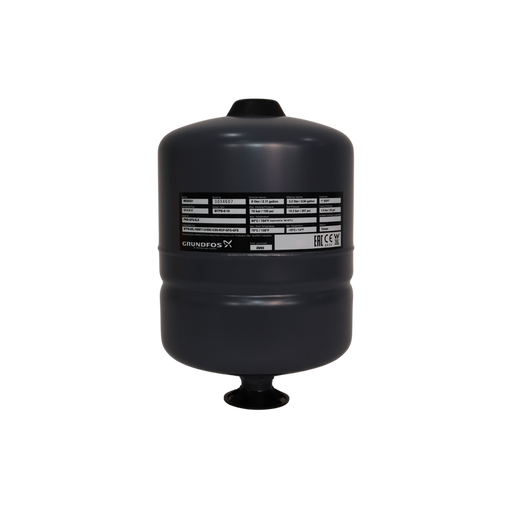
Our pressure tank range runs from small 2 litre units for controller-based systems up to 100 litre tanks for farm and larger domestic duties.
On the Grundfos GT range the code tells you what you need for ordering.
Like the pumps, one tank size can exist as several product numbers. Match the pressure rating and the connection, not just the litres.
Most tank faults show the same symptom — the pump cycles rapidly, sometimes several times a minute, often described by the client as the pump chattering or hammering.
Three checks, in order:
1. Press the Schrader valve. If water comes out instead of air, the bladder has ruptured. The tank is finished. This is the fastest test there is and it settles the question immediately.
2. Tap the shell. With the system drained, tap up the side of the tank. A healthy tank sounds hollow at the top and dull at the bottom, with a clear transition. A waterlogged tank sounds dull all the way up.
3. Lift it. On smaller tanks, a drained tank should feel light. If it still feels heavy with the system at zero pressure, it is full of water it should not be holding.
If the bladder is intact and the tank is simply low on air, recharge it to the correct pre-charge and the problem usually goes away. If it will not hold that charge for a few weeks, replace it.
Worth explaining to clients who baulk at replacing a tank, because the tank is always cheaper than what fails next.
Capacitors go first. Every start puts a surge through the start capacitor. Multiply that by hundreds of extra cycles a day and it fails in months instead of years. If you are replacing capacitors on the same site repeatedly, the tank is the reason. Replacements are in our motor capacitor range.
Then the pressure switch. Contacts arc every switch operation. More cycles, faster wear. See pressure control components.
Then bearings and seals. Repeated starting loads a motor far harder than steady running.
Then the motor. Heat from inrush current has nowhere to go if the pump never runs long enough to cool.
A client who has replaced two pumps in five years does not have bad luck. They have a tank problem nobody diagnosed.

Not every system needs a conventional tank, and on retrofit work this is often the better sell.
Variable speed pumps. A CMBE or a CRE holds a set pressure by changing motor speed rather than switching on and off between two points. There is no cycling to absorb, so the tank requirement shrinks to a small unit for stability — often 2 to 8 litres rather than 60. See CMB and CMBE boosters.
Pressure managers and controllers. A PM unit or similar controller starts on pressure drop and stops on low flow instead of on fixed pressure points. Same effect. Our pump controller range covers these.

When a client's actual complaint is pressure dropping as a second outlet opens, no tank fixes that. That is what a fixed-speed system does by design. Variable speed is the real answer, and saying so up front avoids a return visit.

On bore installations the tank works alongside other protection rather than replacing it.
A tank does nothing about dry running. If the water table drops, the pump will still run itself dry unless something stops it. On the SQ and SQE range that protection is built in. On most other pumps it comes from a controller or a well-placed float switch.
On tank-fed pressure systems, check the pressure tank and the storage tank level control as one job. A float fault and a pressure tank fault produce similar complaints from the client.
For larger multi-outlet sites, staged booster sets handle demand differently again, using duty and standby rather than a single pump and a big tank.
About 14 kPa, or 2 psi, below the pump's cut-in pressure. Always measure it with the system fully drained to zero, or the reading is meaningless.
Not 60 litres. Usable drawdown is typically a quarter to a third of nominal capacity, depending on the pressure band. Expect roughly 15 to 20 litres from a 60 litre tank on a normal domestic system.
Press the Schrader valve. Air means the bladder is intact. Water means it has ruptured and the tank needs replacing. It is the quickest diagnostic on the whole system.
Annually. Tanks lose air gradually through the valve and the bladder. A correctly set tank drifts out of spec over a few years without anything actually failing.
Rarely a problem. An oversized tank means fewer starts and longer pump life. The trade-offs are cost, space and slightly longer to reach pressure from empty. Undersizing causes real damage; oversizing mostly costs money.
A small one, usually. They do not cycle between fixed pressure points, so the large tank is unnecessary, but a small vessel helps stability and stops the pump reacting to tiny draws. Typically 2 to 8 litres instead of 60.
Maximum working pressure. PN10 is rated to 10 bar, PN16 to 16 bar. Multistage pumps can exceed 10 bar, so check the pump's maximum head before specifying. The same capacity in each rating is a different product number.
Usually pre-charge that was never set, or set against a pressurised system. After that, check the pressure switch differential, then look for a leak — a dripping cistern or a weeping fitting will cycle a pump all night regardless of the tank.
Give us the pump model, the cut-in and cut-out settings and what the client is complaining about, and we will tell you what tank the system needs — or whether the real fix is a controller or a variable-speed pump instead.
Call (08) 6384 5884 or send the details through. We stock tanks, controls and spares alongside the Grundfos and Davey ranges, plus seals and wear parts, and we ship Australia-wide. We are at 7 Hampton St, Greenfields WA 6210.
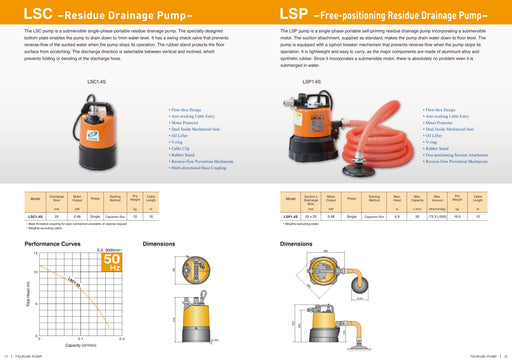
The Tsurumi LSC1.4S is a single-phase submersible portable residue drainage pump designed for ultra low-level water removal down to approximately 1...
View full detailsComplete maintenance kit for ASM D-Series diaphragm pumps, containing essential wear components to restore pump performance and reliability. Design...
View full detailsThe Grundfos GT-H-18 PN10 G1 V is a compact steel pressure tank designed for drinking water applications. It features a non-toxic butyl rubber d...
View full detailsThe Davey Dynapond 8000 is a submersible centrifugal pond pump designed for continuous operation (24/7) in fountains, pond recirculation, wate...
View full detailsThe Tsurumi LSP1.4S is a single-phase portable self‑priming residue drainage pump incorporating a submersible motor, designed for fast removal of s...
View full details