3000+ Pumps & Parts
Pumps On Sale!
Fast Dispatch
A pump pressure tank is the cheapest part of your water system and the part most often bought wrong. If your taps surge, your pump clicks on and off every few seconds, or your bore pump has cooked a motor inside three years, the pump pressure tank is usually the reason. This guide is written for Perth and regional WA conditions: garden bores, sandy soils, long dry summers and the sprinkler roster. By the end you will know how to size a pump pressure tank, how to set one in kPa rather than psi, and which one to put in your cart.
A pump pressure tank is a sealed steel or composite vessel with a rubber diaphragm inside. Air sits on one side, water on the other. When your pump runs, water pushes into the tank and squeezes the air. When you open a tap, that compressed air pushes the water back out. Your pump stays off until the stored water runs down.
That stored water is the whole point. Without a pump pressure tank, your pump has to start every single time someone flushes a toilet or a solenoid opens on a retic zone. With one, the pump sits idle and the tank does the small jobs. A good pump pressure tank also softens water hammer, smooths pressure at the shower head, and gives your pressure switch a stable signal to work from.
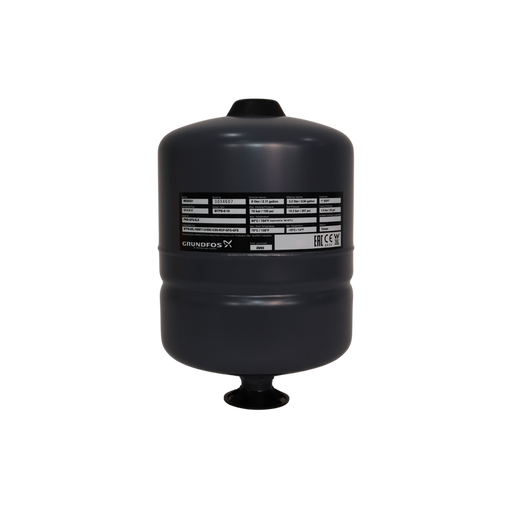
Most Australian systems use a butyl rubber diaphragm rated for drinking water. The Grundfos GT-H range stocked by Pumptastic is a good example, built to PN10 which means a 10 bar working pressure. That rating matters more than people think, because a pump pressure tank on a bore or booster line can see spikes well above normal running pressure.
Short cycling is when a pump starts and stops rapidly, sometimes several times a minute. Every start pulls a heavy inrush current through the motor windings. Motors do not die from running. They die from starting.
The usual cause is a pump pressure tank that has lost its air charge, or a tank far too small for the flow. A waterlogged tank has almost no air left, so the pump has nothing to push against and the pressure switch flicks on and off. On a Perth garden bore running two rostered days a week, that damage is concentrated into a few hours, which is why bore motors here fail earlier than owners expect.
Replacing a pump pressure tank costs a fraction of a new bore pump or a submersible pull. Checking one takes ten minutes with a tyre gauge. If you have never checked yours, that is the first job to do.
Here is the mistake almost every buyer makes. A 60 litre pump pressure tank does not hold 60 litres of usable water. The rated volume is the shell size. The number that matters is drawdown, which is the water you actually get out between the pump switching off and switching back on.
Drawdown depends on your pressure switch settings. On a typical Australian domestic setup with a 200 kPa cut-in and 350 kPa cut-out, and the pump pressure tank pre-charged to about 180 kPa, you get roughly 30 percent of the shell volume as usable water. Widen the gap between cut-in and cut-out and drawdown rises. Narrow it and drawdown falls off fast.
| Rated tank size | Approx. usable drawdown | Typical WA application |
|---|---|---|
| 8 L | About 2.5 L | Booster line, single outlet, water hammer control |
| 18 L | About 5.5 L | Unit, granny flat, one bathroom, small retic zone |
| 35 L | About 11 L | Average Perth home on bore or rainwater |
| 60 L | About 19 L | Large home, multiple retic zones, long pipe runs |
| 100 L | About 31 L | Rural home, farm shed, light commercial |
Figures assume 180 kPa pre-charge, 200 kPa cut-in and 350 kPa cut-out. Change the switch settings and the numbers change with them.
As a working rule, aim for enough drawdown that your pump runs for at least one minute per start under normal demand. If you cannot get there with one pump pressure tank, fit two in parallel. Plumbers do this on Perth homes all the time and it works.
Almost every guide you find online is American. It talks about psi, well pumps and 30/50 switches. Australian gear is set in kPa or bar, so here is the local version.
Set the air pre-charge in an empty pump pressure tank to roughly 10 to 15 percent below your pump's cut-in pressure. If your switch cuts in at 200 kPa, aim for about 175 to 180 kPa. If it cuts in at 150 kPa, aim for about 130 to 135 kPa. Always check your tank and pump manuals first, because some manufacturers specify their own figure.
To do it: isolate power to the pump, open the lowest tap and drain the system until the gauge reads zero, then check the Schrader valve on the top of the pump pressure tank with a tyre gauge. Add air with a compressor or bleed it off until you hit target. If water sprays out of the Schrader valve, the diaphragm has split and the tank needs replacing, not recharging. Pre-charge set too high starves you of drawdown and creates a dead spot at the tap. Set too low, the diaphragm stretches past its limit and fails early. Check it every twelve months, ideally before summer.
About 180,000 households across Perth and Mandurah run a garden bore, which is roughly one in four homes. Under the sprinkler roster, bore users can water two days a week between 1 September and 31 May, once a day, before 9am or after 6pm, with a Winter Sprinkler Switch-Off from 1 June to 31 August. Breaching it carries a $100 fine.
That roster changes how you should size a pump pressure tank. All of your watering is crammed into two mornings or two evenings, which means high flow for a short burst rather than steady light use. A tank that copes with a single tap will hammer itself apart running a full retic cycle. Size for your biggest zone, not your average day.
Perth groundwater from the Superficial aquifer is often high in iron. Iron and the bacteria that feed on it build sludge inside a pump pressure tank, coat the diaphragm and shorten its life. If your bore water stains paving orange, budget on shorter tank life, choose a tank with a replaceable diaphragm where possible, and keep a spare pressure switch on the shelf. Pairing the tank with a properly matched submersible bore pump is what turns a patchy retic system into one that finishes its cycle in the window you are allowed to use.
Steel tanks such as the Grundfos GT-H are the default for Australian homes. They are strong, cheap for the litreage, and easy to find in 8 L through to 100 L and beyond. Their weak point is corrosion, so keep them off wet ground and out of direct sun where you can.
Composite tanks cost more but shrug off corrosion, which makes them a smart pick for coastal WA, salty bore water, and anywhere near the ocean from Cottesloe to Geraldton. Inline or port-mounted tanks in the 2 L to 8 L range are not really storage at all. They are there to stop a pressure switch chattering on a booster set, and they suit pressure booster systems and circulation lines.
There is also a fourth option worth knowing. A constant pressure controller such as the Davey Torrium2 fitted to a Davey pressure system manages starts electronically and needs only a small pump pressure tank, or sometimes none at all. If you want steady pressure with two showers running, that is the direction to look. Not sure which way to go? The water pump vs pressure tank comparison breaks it down further.
Commercial buyers care about a different number: cost of downtime. On a Wheatbelt farm, a Pilbara camp or a Bunbury factory, a failed pump pressure tank means stock without water or a production line stopped. Specify up, not down.
For multi-outlet commercial buildings, sizing is driven by peak simultaneous demand and permitted motor starts per hour, not by household rules of thumb. Most engineers pair a larger pump pressure tank with a vertical multistage pump or a Grundfos booster set, then use variable speed control to hold pressure flat. The tank still earns its place by covering small leaks and low overnight draw so the pump is not starting all night.
For plumbers, irrigation contractors and pump servicers buying repeatedly, standardising on one pump pressure tank family cuts van stock and callback times. Pumptastic supplies trade volumes with Australia wide dispatch and free shipping on orders over $100, so you can hold a small kit of tanks, pump controllers and capacitors instead of chasing parts mid-job.
Tap the side of the tank. The top should sound hollow and the bottom dull. If the whole pump pressure tank sounds solid and full, it is waterlogged. Second, the pump starting and stopping every few seconds while a single tap runs. Third, pressure that surges then drops away at the shower.
Fourth, water coming out of the Schrader valve when you press it, which means the diaphragm is torn. Fifth, a tank that feels far heavier than it should when you rock it. Any one of these means the pump pressure tank is no longer doing its job and your pump is wearing out in its place.
Buy on specification, not on price per litre. Match the pressure rating to your system, size on drawdown, and check the thread and connection type before ordering. A Grundfos GT-H-18 suits a small home or unit, while a Grundfos GT-H-60 handles a full family home on bore or rainwater.
Pumptastic stocks the full pump pressure tank range alongside matched water pump and pressure tank systems, with fast dispatch across Perth and regional WA and free shipping on orders over $100. If you are unsure what fits your bore, your retic layout or your building, call the team on (08) 6384 5884 before you order. Ten minutes on the phone beats a return freight bill.
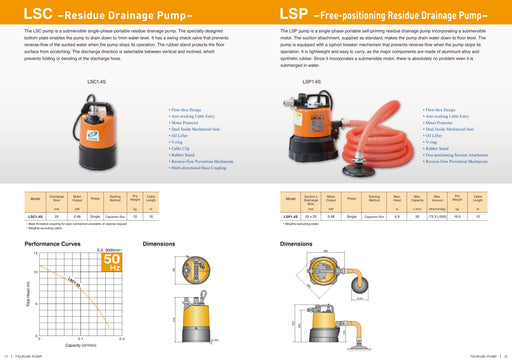
The Tsurumi LSC1.4S is a single-phase submersible portable residue drainage pump designed for ultra low-level water removal down to approximately 1...
View full detailsComplete maintenance kit for ASM D-Series diaphragm pumps, containing essential wear components to restore pump performance and reliability. Design...
View full detailsThe Grundfos GT-H-18 PN10 G1 V is a compact steel pressure tank designed for drinking water applications. It features a non-toxic butyl rubber d...
View full detailsThe Davey Dynapond 8000 is a submersible centrifugal pond pump designed for continuous operation (24/7) in fountains, pond recirculation, wate...
View full detailsThe Tsurumi LSP1.4S is a single-phase portable self‑priming residue drainage pump incorporating a submersible motor, designed for fast removal of s...
View full details