3000+ Pumps & Parts
Pumps On Sale!
Fast Dispatch

If you’re a tradie, site manager, plumber, or homeowner in Australia dealing with sudden stormwater, muddy pits, or stubborn groundwater, you don’t need another overhyped gadget you need a workhorse that starts, pumps, and survives the abuse. That’s exactly why the Tsurumi LB-480 Single Phase Portable Slimline Submersible Drainage Pump with a semi-vortex impeller keeps showing up on Aussie job sites. It’s compact, brutally reliable, and built for real-world dewatering construction trenches, basements, tanks, pits, and emergency flood clean-ups.
This guide cuts through marketing fluff and explains what the LB-480 does well, where it fits, and how to choose and maintain it so you’re not replacing pumps mid-job. You’ll also get a practical sizing checklist, a no-nonsense maintenance routine, and clear answers to common questions Australians ask about submersible drainage pumps.
Portable, slimline profile that drops into narrow pits and tight formwork without fuss.
Single-phase 240V operation plug it in and go on standard Australian power.
Semi-vortex impeller design that moves dirty water with fines, silt, and light slurry without clogging as easily as closed-vane impellers.
Proven durability from Tsurumi’s build standards abrasion-resistant materials, mechanical seal protection, and a design that tolerates rough handling.
True “job box” pump: simple to set up, easy to run, and hard to kill.
Great fit for:
Builders and concreters needing fast dewatering of footings and trenches before the pour.
Plumbers emptying inspection pits, valve boxes, or small tanks.
Facility managers dealing with basement seepage or stormwater buildup.
Homeowners and farmers who want a reliable, portable pump for occasional flooding or tank transfers.
Hire fleets that need robust, low-comeback pumps.
Not the right tool if:
You’re moving heavy slurry, sand, or gravel all day look at a dedicated trash/slurry pump instead.
You need very high head (multi-storey head pressures) or long horizontal runs step up in the range or consider a different impeller/horsepower.
You require strict solids handling for large debris opt for a vortex or trash configuration designed for bigger solids.
A semi-vortex impeller creates a swirling flow path that helps suspended solids bypass the blade edges, reducing clog risk and maintaining flow as water gets dirty. Practically, that means the LB-480 keeps pumping when the water turns silty, or when fine aggregate and cement washout are present near the slab. It’s not a license to pump pea gravel; it is a license to keep momentum in the mess you actually encounter on Australian sites after rain or during washdown.
Choosing a submersible drainage pump is 80% sizing and 20% luck. Get the 80% right and you’ll save money, time, and your sanity.
Total Dynamic Head (TDH)
Add up vertical lift + friction losses.
Vertical lift: the height from water surface to discharge point.
Friction: every metre of hose, elbows, reducers, and check valves add resistance.
If you’re running long 2" layflat hose uphill, don’t pretend friction is zero give yourself margin.
Flow rate you actually need
Draining a 2,000 L pit in 10 minutes implies ~200 L/min (12,000 L/h). Build in a buffer so you don’t sit around clock-watching while labour costs tick up.
Solids/fines handling
If you’re pulling from muddy, sandy, or silty water, a semi-vortex design is your friend. If the water has chunky debris, you picked the wrong pump class.
Duty cycle
Will the pump run continuously for hours, or cycle on/off occasionally via a float switch? Continuous duty demands better heat management and robust seals one of Tsurumi’s strengths.
Power availability
The LB-480 is single-phase 240V. If your site has only GPO access, that’s perfect. If you plan to run two or more pumps off the same circuit, check your amperage and avoid nuisance trips.
Hose and fittings
Keep discharge diameter consistent with the pump outlet to avoid choking flow. Match 2" hose to a 2" outlet unless you’re intentionally boosting head by downsizing (which increases friction trade-offs apply).
Pre-use check (60 seconds): Inspect the power cable and strain relief; check the strainer for stones; confirm the hose/clamps are tight.
During use: Keep the pump submerged while operating to avoid dry running and overheating. If water recedes, shut it down.
Post-use clean: Flush with clean water. Silt left inside the volute is slow-motion sabotage.
Periodic: Inspect the mechanical seal oil chamber (if applicable on your maintenance schedule), check the wear plate/impeller for abrasion, and replace consumables before they become failures.
Storage: Dry the hose, coil the cable without sharp bends, and store upright to protect seals.
Do that, and you’ll dramatically extend the LB-480’s service life.
Sydney/Melbourne/Brisbane metro sites: Rapid dewatering of trenches before inspections, concrete pours, and waterproofing stages.
Coastal QLD/NSW properties: Seasonal stormwater management for low-lying yards, garages, and basements.
Regional VIC/SA/WA farms: Tank transfers, trough cleaning, and pump-out of sumps after rain events.
Emergency response: Flash-flood clean-up where portability and fast setup matter more than laboratory specs.
Undersized pump = rework, idle labour, inspection delays, and blown timelines.
Oversized pump = wasted capex/opex, excessive power draw, and more wear than you need.
Wrong impeller type = clogs, burnt seals, and warranty arguments you don’t have time for.
A correctly chosen LB-480 avoids all three failure modes for common Australian drainage tasks.
Portability: The slimline body slips past reo, shoring, and tight formwork where bulkier pumps won’t. That translates to less site rearranging and more pumping.
Durability: Tsurumi’s signature approach high-quality mechanical seals, thoughtful cable entry, and abrasion-resistant internals means it tolerates the grit that would chew through bargain pumps. Over a year, the total cost of ownership usually beats cheaper imports once you factor reduced downtime and replacements.
Performance envelope: It’s made for dirty water, not boulders. In Australian storm events, that’s a sweet spot: fines, silt, and clay-laden water are common; big solids are less so when you’ve got a strainer in place.
Positioning: Drop the pump on a stable surface (a paver or perforated crate) to elevate the inlet above settled sludge.
Strainer discipline: Keep the inlet mesh clear. A $5 brush saves a $500 repair.
Hose routing: Lay discharge uphill with minimal kinks. Use proper camlocks or clamps; tape is not a strategy.
Backflow control: A check valve helps hold prime in intermittent pumping and reduces surge back into the pit when you shut down.
Power safety: Use an RCD-protected circuit. Avoid running the cable across traffic paths where it’ll get crushed.
Float switch kit: For sumps or basements where water rises randomly, a float makes the system automatic no babysitting required.
Pre-filter sock or screen: If your pit is full of fines, a sacrificial pre-filter reduces impeller wear and keeps you pumping longer.
Secondary pump: For large slab pours during wet seasons, run two units in parallel into a Y-piece to hold your schedule without stepping up to a heavier three-phase unit.
1) Can a submersible drainage pump like the Tsurumi LB-480 handle muddy water after storms?
Yes, this is what a semi vortex impeller pump is for. It moves dirty water with fines and silt more reliably than a closed-vane impeller. It’s not meant for large solids; keep the strainer clear and avoid gravel.
2) Is single-phase 240V enough for construction site dewatering Australia-wide?
For typical trenches, pits, and basements, a portable submersible pump 240V like the LB-480 is plenty. When you need higher head or heavy solids throughput for long runs, step into higher-power or three-phase models.
3) What hose should I use with a stormwater pump 2 inch outlet?
Use a 2" layflat (or flexible PVC) with quality fittings. Keep the diameter consistent to preserve flow; downsizing increases friction and crushes performance over distance.
4) Can I use the LB-480 as a basement flood pump Australia situations?
Absolutely. It’s compact enough for tight spaces and strong enough to clear standing water quickly. Add a float for automatic operation and route discharge safely to stormwater (complying with local council rules).
5) How do I know if I need a trench dewatering pump or a dirty water pump for builders with more solids handling?
If your water has debris bigger than fines (leaves, cable ties, small stones), you’re entering trash pump territory. If it’s mainly muddy water and silt, the LB-480 hits the sweet spot.
If you’re ready to deploy a submersible drainage pump that doesn’t muck around, start here:
Explore our range of Tsurumi Pumps long-term favourites on Aussie job sites: Tsurumi Pumps
Want a quick shortlist or a sizing sanity check? Contact us for straight answers and fast recommendations.
Learn more about who we are and why trade customers rely on us: Pumptastic
Want more options in the same family? See more Tsurumi Pumps
Choose the LB-480 if you need:
A reliable, portable, single-phase pump for dirty water.
A slimline submersible pump that fits tight pits and formwork.
Lower clog risk from a semi-vortex impeller without jumping to a heavy trash pump.
A proven brand with parts and support in Australia.
Look beyond it if you need:
High head for multi-storey lifts or very long discharge runs.
Large solids handling all day, every day.
Industrial three-phase duty with extreme throughput.
Pre-filter in clay soils: A simple mesh sleeve reduces fines ingestion.
Dedicated hose: Don’t share layflat with concrete washout lines; cement fines accelerate wear.
Routine flush: Run fresh water through the pump at the end of each job day.
Spare fittings on hand: Keep camlocks, clamps, and a spare check valve in your kit downtime is more expensive than hardware.
Get the right pump, first time. Browse Tsurumi Pumps or See more Tsurumi Pumps, learn more about Pumptastic, or Contact us for fast, expert help sizing your submersible drainage pump for Australian conditions.
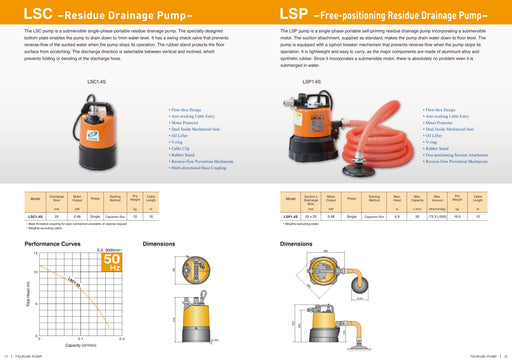
The Tsurumi LSC1.4S is a single-phase submersible portable residue drainage pump designed for ultra low-level water removal down to approximately 1...
View full detailsComplete maintenance kit for ASM D-Series diaphragm pumps, containing essential wear components to restore pump performance and reliability. Design...
View full detailsThe Grundfos GT-H-18 PN10 G1 V is a compact steel pressure tank designed for drinking water applications. It features a non-toxic butyl rubber d...
View full detailsThe Davey Dynapond 8000 is a submersible centrifugal pond pump designed for continuous operation (24/7) in fountains, pond recirculation, wate...
View full detailsThe Tsurumi LSP1.4S is a single-phase portable self‑priming residue drainage pump incorporating a submersible motor, designed for fast removal of s...
View full details