3000+ Pumps & Parts
Pumps On Sale!
Fast Dispatch

In Australia, managing water particularly excess water, flood-prone areas, basements, shallow sump pits or even residential sites after heavy rain can pose real challenges. Choosing the right pump isn’t just about “one size fits all”. You need a unit that meets the local conditions: Australian mains voltage (240 V, 50 Hz), single phase options, portability, effective self-priming, and robust design for harsh or variable environments. The Tsurumi LSP1.4S steps into that gap. This blog looks at how this pump works, why it’s especially relevant for Australian homes and sites, what to look for in a drainage pump, and how to integrate it into your property or project.
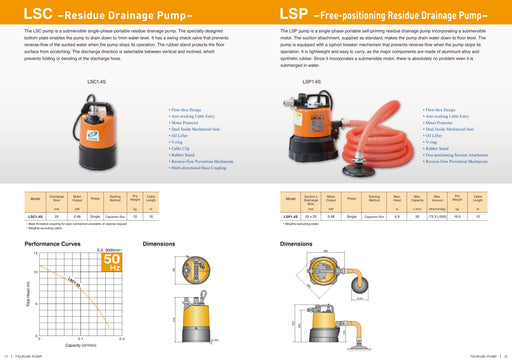
The LSP1.4S is described as a “single phase portable self-priming submersible drainage pump with suction attachment”.
Here are its key features:
Motor output: 0.48 kW (approx. 0.64 HP).
Discharge bore: 25 × 25 mm; single phase; capacitor run starting.
Self-priming capability: Equipped with a siphon breaker mechanism to prevent reverse-flow when the pump stops
Supplied suction attachment that allows the pump to drain water down to floor level or shallow recesses.
Lightweight aluminium alloy and synthetic rubber construction allows easier portability.
240 V, 50 Hz compatibility (Australian standard).
In short: for many Australian residential, commercial or light-industrial drainage uses this unit ticks the right boxes: single-phase compatibility, decent output for residual water, and portability.
Australia presents some unique drainage challenges. Whether it’s heavy rainfall in coastal NSW or QLD, basement pits in inner‐city Melbourne, or floodwater in Western Australia, you often face:
Shallow pools of water in basements or utility pits that aren’t suited to large sump basin systems.
Residual water e.g., after construction, renovation clean-up, or site dewatering.
Drainage tasks where the pump may sit partially submerged but must operate reliably in variable conditions, including low water levels or with sediment/residue.
Requirements for portability: trades, sites, contractors often need gear that is easy to transport and set up.
The LSP1.4S addresses these by offering a self-priming mechanism, effective for shallow drainage, and a compact footprint. For example, its design supports “low water draining mechanism” so that it works in shallow spaces.
In a market where many domestic drainage pumps are either too heavy, three-phase, or not built for Australian mains/conditions, having a single-phase, Australian-compatible unit is a strong advantage.
Here’s how these features translate into real benefits:
Many residential or light commercial properties in Australia only have single-phase supply. A single-phase pump like the LSP1.4S avoids needing specialised three-phase power or complex wiring. That lowers installation complexity and cost.
With the built-in siphon breaker mechanism the pump prevents back-flow when it stops. That means less risk of water returning into the pit when the pump is off. Useful in flood-prone or low-lying sites.
At around 16.5 kg for this model (dry weight excluding cable) according to specification. That makes it manageable for one person to carry, move, set up. Ideal for site-works, as a backup unit, or for contractors.
Thanks to the suction attachment and low-water draining mechanism, the pump is suitable for draining residual water down to near floor level in utility areas, basements or shallow pits. That means minimal water left behind.
Since it’s stocked in Australia (see Aussie-based product listing) the buyer has the benefit of local support, shipping, and compatibility assurance.
Before simply ordering a pump, check the following to ensure it fits your specific Australian application:
Water Depth / Head & Flow Requirements
The LSP1.4S maximum head is 6.9 m according to the model spec. If you need to pump water up a higher elevation (such as from a basement to the street level), you’ll need to check that the head is sufficient. Also check flow rate at your required head.
Cable Length & Electrical Setup Does the pump include sufficient cable length for your installation? In one listing it shows 10 m cable. Also check power supply: single phase, and the plug/inlet should be Aussie-compatible and safe.
Suitability for Site/Water Conditions If the pump will be used in water with sediment, debris or sand, you’ll need to ensure the impeller type and casing are suitable for “residual water”. The LSP series is aimed at “residue drainage”. If you expect heavy solids, you might need a different model.
Installation & Maintenance Requirements Even though it’s portable, you should plan anchoring, pick-points, hose routing, priming if required, and ongoing maintenance (bearing checks, mechanical seal inspections). While the LSP1.4S is built for durability, all pumps still demand some due diligence.
Here are practical examples of how you might deploy this pump in Australia:
You’ve got a basement or utility room where water accumulates. The suction attachment allows you to drain down near floor level. Place the pump so the suction hose covers the pit bottom, and run the discharge hose to your stormwater drain or approved outlet.
In flood-prone areas (e.g., coastal NSW, Queensland), after the main event you need to remove large volumes of residual water. The pump’s portability lets you deploy quickly to shallow pools, drain down water before final drying and clean-up.
If you’re a contractor or builder, often you’ll need a portable pump for residual water in pits, trenches or flats after rainfall. The LSP1.4S suits that role: single-phase power means no special wiring, portability means ease of relocation.
The specification includes decorative waterfalls and fountains among applications. If you run a hotel, cafe or commercial building with water features or shallow sump pits, the pump offers a robust solution.
Ensure your suction and discharge hoses are rated for Australian mains pressure and UV exposure.
Regularly inspect the pump’s cable and plug for wear, especially if used outdoors.
Even though it’s built for shallow operation, if used in very sandy or sediment-laden water, flush and inspect more often.
If the pump is idle for long periods (e.g., standby floodwater mitigation), run it periodically to confirm operation.
Store the pump in a dry, covered environment when not in use. Because of portable nature, damp storage can reduce longevity.
While price fluctuates, one listing in Australia shows a current sale price of AUD $978 (incl shipping Australia-wide). That positions the LSP1.4S in the “premium but compact” category for residential/pro-site drainage.
One risk I have to flag: many buyers underestimate the “head” requirement pumping water up into stormwater mains or over a lip can dramatically reduce flow. Make sure you calculate required head + hose length. If you overshoot the head rating of 6.9 m the flow rate will fall and you may end up with an underperforming solution.
Here are five questions many Australian buyers ask with straight answers:
1. Can this pump be used in a typical Australian house basement or laundry pit?
Yes. Its single-phase 240 V compatibility means no special power issues, and the suction attachment lets it operate down to near-floor level. Just confirm pit size, hose routing and head requirement.
2. Will it work during heavy flood events or large volumes of water?
It will handle a lot of residual water, but it’s not a heavy industrial dewatering pump for extremely high flow or high head. For very large flood volumes you may need a larger model. For moderate floodwater or shallow pooling, it’s a solid choice.
3. Is the pump portable and easy to move between sites?
Yes. At ~16–17 kg dry weight, it’s portable for one person. The supplier lists it as “lightweight and easy to carry”. If your site involves vertical movement or stairs, check that the weight plus hoses is manageable.
4. What power supply does it require? Can I plug it into a standard Australian power outlet?
Yes, standard Australian single‐phase 240 V, 50 Hz. Many residential outlets and site outlets will support it. Always ensure plug, earth, and power path are compliant with Australian electrical regulations.
5. How low can it drain water? Will it leave a puddle behind?
Thanks to the suction attachment and low-water draining mechanism, it can drain shallow water very effectively. The manufacturer claims “floor level” drainage. However, in real‐world use there may still be a small film of water left depending on pit shape or suction hose placement. Good practice is to position the suction hose close to the lowest point and keep hose free of kinks.
In the Australian context, many alternatives either: (a) require three-phase power; (b) are too bulky/heavy; (c) are not self-priming or suited to shallow water; or (d) local support is weak. The Tsurumi LSP1.4S stands out because:
It matches Australian power supply and local market requirements.
It’s from a brand with recognised engineering and global reputation.
It combines self-priming, portability, and shallow drainage in one unit.
Local suppliers (including this one via your site) means easier service & parts.
Good value for a specialist drainage pump in its class.
Be honest about limitations:
If you need to pump water up more than ~7 m vertical head or over very long hose runs, flow will drop or you may need larger pump.
If the water stream carries heavy solids, sludge or sand constantly, you may need a heavy-duty slurry pump rather than a standard residue drainage pump.
If continuous heavy industrial duty (24/7) is required, premium industrial-grade units might serve better.
If you need automatic float switch/auto operation rather than manual start, check that model variant or a different series.
If you’re an Australian homeowner, contractor, site manager or engineer looking for a single‐phase, portable, self‐priming submersible drainage pump for shallow-depth drainage, residual water, flood-recovery, or utility pit use, the Tsurumi LSP1.4S is a compelling option. It marries real engineering capability with practical portability and local power compatibility.
Use the criteria above to check suitability against your site specifics (head, length, water type, solids content). If it fits, you’ll get a robust, efficient solution that reduces risk of downtime and supports many drainage scenarios.
For further product details or to discuss how this pump fits into your project or home setup, feel free to visit our site: Pumptastic and if you’d like direct help or specification advice, reach out via our Contact us page.
The Tsurumi LSC1.4S is a single-phase submersible portable residue drainage pump designed for ultra low-level water removal down to approximately 1...
View full detailsComplete maintenance kit for ASM D-Series diaphragm pumps, containing essential wear components to restore pump performance and reliability. Design...
View full detailsThe Grundfos GT-H-18 PN10 G1 V is a compact steel pressure tank designed for drinking water applications. It features a non-toxic butyl rubber d...
View full detailsThe Davey Dynapond 8000 is a submersible centrifugal pond pump designed for continuous operation (24/7) in fountains, pond recirculation, wate...
View full detailsThe Tsurumi LSP1.4S is a single-phase portable self‑priming residue drainage pump incorporating a submersible motor, designed for fast removal of s...
View full details