3000+ Pumps & Parts
Pumps On Sale!
Fast Dispatch
If you've ever turned on a tap in Perth, watered a lawn in Brisbane, or filled a rainwater tank in regional Victoria, there's a strong chance a centrifugal pump made it happen. From the dusty paddocks of the Murray-Darling Basin to high-rise apartments in Sydney, this single piece of engineering quietly powers most of the country's water movement. So why has Australia a continent shaped by drought, sprawling farmland, and tough water regulations fallen so heavily in love with this one type of pump? Let's break it down.
A centrifugal pump is a mechanical device that moves water by spinning an impeller inside a sealed casing. The rotating impeller converts motor energy into kinetic energy, then into pressure pushing water through pipes, tanks, sprinklers, and pressure systems with consistent flow. Compared to positive displacement pumps, a centrifugal water pump is simpler, cheaper to maintain, and capable of handling the high flow rates that Australian properties demand. That's the short answer to why builders, plumbers, farmers, and homeowners across NSW, QLD, VIC, WA, SA, and TAS keep choosing them.
Australia's water systems are uniquely demanding. Long pipe runs from rainwater tanks, deep bore water in Western Australia, hard-water sources in South Australia, and the need to push water uphill on rural properties all of these favour pumps that are efficient, reliable, and serviceable. Centrifugal pumps tick every box, which is why brands like Grundfos, Davey, Onga, Ebara, and Tsurumi dominate the local market.
Ready to upgrade your water system? Browse Pumptastic's full range of centrifugal pumps and water pumps online free shipping Australia-wide on orders over $100.
Most Australian homes connected to mains water still suffer from inconsistent pressure especially two-storey houses, properties at the end of council mains, and homes using tank water. A centrifugal water pump paired with a pressure tank delivers steady, shower-ready pressure without screaming pipes or sudden pressure drops when someone flushes a toilet.
For irrigators across the Riverina, the Atherton Tablelands, and the Mallee, a centrifugal pump is the workhorse that moves megalitres of water from dams, rivers, and bores into drip lines and sprinklers. Their ability to handle high volumes at moderate head pressure is exactly what broadacre farms, vineyards, orchards, and turf farms need.
Not sure which model fits your property? Read our deep dive: Best Centrifugal Pumps for Australian Homes, Irrigation & Commercial Use a real-world comparison built for Aussie conditions.
Here's the science in plain English. Water enters the suction inlet at the centre of the pump (the impeller eye). As the impeller spins usually driven by an electric motor centrifugal force throws the water outward at speed. The volute (the curved casing surrounding the impeller) slows the water down and converts that velocity into pressure. The pressurised water exits through the discharge port and travels through your plumbing, irrigation lines, or pressure tank.
The beauty of this design is its simplicity. There are very few moving parts. There are no valves inside the pump body, which means a centrifugal pump can handle suspended solids better than many alternatives. And because the impeller can be matched to almost any flow and head requirement, the same fundamental design scales from a tiny garden booster to a heavy-duty mining dewatering pump. This is also why energy efficiency standards in Australia including the Minimum Energy Performance Standards (MEPS) administered under the Greenhouse and Energy Minimum Standards (GEMS) Act focus so heavily on centrifugal pump efficiency.
A single-stage centrifugal pump has one impeller. It's perfect for general transfer, pool circulation, and basic pressure boosting where moderate head is needed. A multistage pump, on the other hand, stacks multiple impellers in series each one adding more pressure. The result is the same flow rate but dramatically higher pressure, which is essential for tall buildings, long pipe runs, deep bore water systems, and reverse osmosis feed.
In Australia, multistage pumps are the go-to for two-storey homes on tank water, commercial buildings, irrigation networks with elevation changes, and bushfire fighting systems where pressure matters more than raw volume. The Grundfos CM and CMB series are the most commonly specified horizontal multistage pumps in the country, while the Grundfos CR vertical multistage range handles serious commercial work.
Buying a Grundfos? Don't guess get it right the first time. Our Grundfos Centrifugal Pump Buying Guide: Which Model Is Right for Your Application? walks you through CM, CMB, CR, MQ and JP series with real flow charts and price comparisons.
Walk into any plumbing supply yard from Geraldton to Cairns and you'll see Grundfos blue. There's a reason. Grundfos the Danish pump manufacturer founded in 1945 engineers its pumps for energy efficiency, stainless steel construction, and long service life in tough water conditions. A Grundfos centrifugal pump typically uses 316 stainless steel components that resist Australia's harder waters, ceramic shaft seals, and IE3-rated motors that cut electricity bills over time.
Pumptastic stocks the full Grundfos range, from the Grundfos CMB pressure pumps for home pressure boosting, to the Grundfos Vertical Multistage CR series for commercial systems, plus the Grundfos SQ and SQE submersible bore pumps used in rural Western Australia and Queensland.
Centrifugal pumps power far more than you'd expect. In residential properties, they handle rainwater tank pressure boosting, pool circulation, hot water recirculation, and garden irrigation. In agriculture, they drive flood irrigation, drip systems, livestock troughs, and dam-to-tank transfers. In commercial buildings, they manage HVAC chilled water loops, fire sprinkler systems, and potable water boosting. Local councils use them for stormwater management and sewage treatment. Mining sites across the Pilbara and Bowen Basin rely on heavy-duty versions for dewatering shafts and slurry handling.
This versatility is exactly why Australian Standards AS/NZS 3500 (plumbing and drainage) and the Water Services Association of Australia's WaterMark certification scheme make centrifugal pumps the default specification for most water applications.
Need help sizing or sourcing? Call the Pumptastic team on (08) 6384 5884 or shop centrifugal pumps online with same-day dispatch from our Australian warehouse.
Three numbers matter most: flow rate (litres per minute), total dynamic head (the vertical lift plus pipe friction), and the power source available (single-phase 240V or three-phase 415V). After that, you're looking at the pumped fluid, whether you need self-priming capability, the housing material (cast iron, stainless steel, or composite), and the duty cycle. Get those right and a quality centrifugal pump will give you 10–15 years of dependable service.
If you're unsure, don't gamble. Australian water conditions vary wildly between Karratha bore water and Melbourne mains, and the wrong pump choice can mean burnt-out motors, cavitation damage, and warranty headaches. Pumptastic's pump experts have been helping Australians choose the right centrifugal pump for over a decade and the advice is free.
Centrifugal pumps dominate Australian water systems because they're simple, scalable, efficient, and built to handle everything from Sydney mains pressure boosting to outback bore water. Whether you're a homeowner replacing a failed pressure pump, a farmer expanding irrigation, or a builder specifying a fire booster, the right centrifugal pump will outlast almost every other component in your water system.
Stop overpaying at the local plumbing yard. Shop Pumptastic's centrifugal pump range online top brands, expert advice, and free shipping over $100. Or call (08) 6384 5884 for tailored recommendations.
Centrifugal pumps are used for pressure boosting in homes, irrigation on farms, pool circulation, fire fighting systems, HVAC, sewage treatment, and bore water extraction. They're the most common pump type in Australian water systems because they handle high flow rates efficiently and need minimal maintenance.
For low-viscosity fluids like water, yes. Centrifugal pumps deliver higher flow rates, cost less to operate, and have fewer moving parts. Positive displacement pumps are better for thick fluids like oils, slurries with high solids, or applications needing exact dosing.
A quality centrifugal water pump from brands like Grundfos, Davey, or Onga typically lasts 10–15 years with proper installation and basic maintenance. Cheap imports often fail within 2–3 years, which is why most Australians invest in a name brand from the start.
A single-stage pump has one impeller and delivers moderate pressure. A multistage pump uses multiple impellers stacked in series to generate much higher pressure at the same flow rate ideal for two-storey homes, deep bore water, and commercial buildings.
The Grundfos CMB-SP series is the most popular Grundfos centrifugal pump for Australian homes it combines a pressure pump with a built-in pressure tank and controller for plug-and-play installation. For larger homes or two-storey properties, the Grundfos CM 3-stage or 5-stage models are excellent choices.
No. Running a centrifugal pump dry will destroy the mechanical seal within minutes and can warp the impeller. Always install a dry-run protection device or pressure controller Pumptastic stocks Grundfos PM2, Davey Torrium, and similar controllers.
Entry-level centrifugal water pumps for garden use start around $200. Quality home pressure pumps from Grundfos, Davey, or Onga sit between $400 and $1,200. Commercial multistage pumps and bore pumps range from $1,500 to $8,000+ depending on flow, head, and motor power.
Most do, they need water in the suction line to operate. However, self-priming centrifugal pumps can evacuate air from the suction line and start pumping on their own, which is useful for rainwater tanks and shallow well applications.
Grundfos pumps are manufactured globally primarily in Denmark, Germany, China, and the US but they're distributed through an extensive Australian network. Pumptastic is an authorised Grundfos reseller offering genuine product with full Australian warranty.
For a standard 3-bedroom Australian home on tank water, a pressure pump delivering around 60–80 L/min at 40–50m head is typically sufficient. For larger homes, two-storey properties, or homes with multiple bathrooms used simultaneously, a multistage pump is recommended. Call Pumptastic on (08) 6384 5884 for free sizing advice tailored to your property.
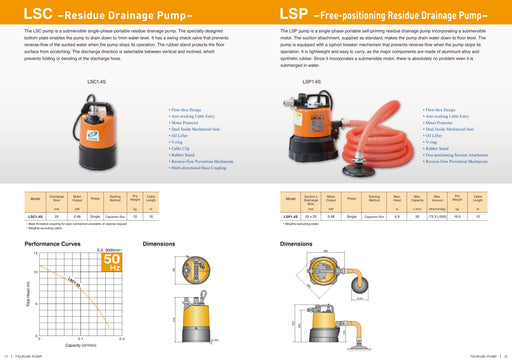
The Tsurumi LSC1.4S is a single-phase submersible portable residue drainage pump designed for ultra low-level water removal down to approximately 1...
View full detailsComplete maintenance kit for ASM D-Series diaphragm pumps, containing essential wear components to restore pump performance and reliability. Design...
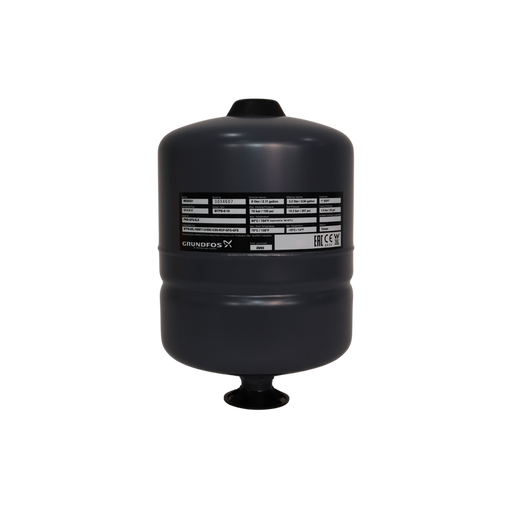
View full detailsThe Grundfos GT-H-18 PN10 G1 V is a compact steel pressure tank designed for drinking water applications. It features a non-toxic butyl rubber d...
View full detailsThe Davey Dynapond 8000 is a submersible centrifugal pond pump designed for continuous operation (24/7) in fountains, pond recirculation, wate...
View full detailsThe Tsurumi LSP1.4S is a single-phase portable self‑priming residue drainage pump incorporating a submersible motor, designed for fast removal of s...
View full details